
The Human Condition
Humans as a species are remarkably calm when it comes to emotional (reactive) aggression, our communities are incredibly peaceful, unlike many animal ones, where fighting between males is rife.
But we also have the ability to commit abhorrent acts of premeditated cruelty (proactive) to others.
This dichotomy is what makes us human and may have shaped our whole evolution from early Homo.
Capital Punishment
Reactive and proactive aggression are rooted into different brain structures, and thus by executing reactive aggressors only the calmer individuals pass genes on.
The crucial first step was to evolve language, and subsequently plot and scheme to remove domineering individuals and using collaborative proactive aggression.
Execution of aggressive people is a form of selection that we have artificially created, rather than selecting for fitness, calmness became our selection pressure and we domesticated ourselves.
Other Domesticates
As a consequence of domestication though, morphological changes comprising the ‘Domestication Syndrome’ emerge in everything from rats to dogs to cows in different combinations.
These changes include:
- Floppy/reduced ears
- White fur colouration
- Reduced jaws and teeth
- Curly tails
- Smaller brains
- And most importantly, Docility
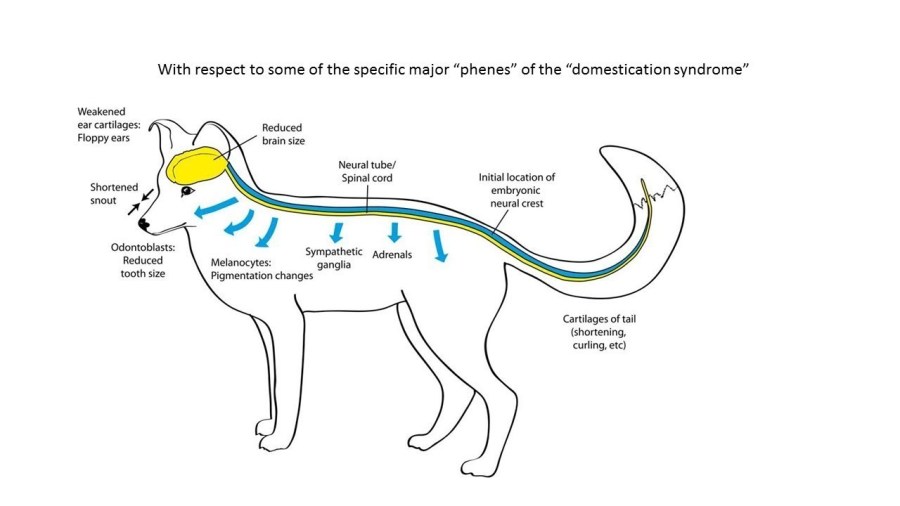
Symptoms of the Domestication Syndrome in foxes (Image: Adam S. Wilkins, Richard W. Wrangham and W. Tecumseh Fitch, https://doi.org/10.1534/genetics.114.165423)
Bonobos (Pan paniscus) share many of these features when compared to chimpanzees (Pan troglodytes) in addition to a lot of childlike (paedomorphic) traits:
- Retention of pink lips, white tail & toes for longer
- Later offspring independence
- Adult play
- Adult homosexuality
All of these features bar a few are present in modern day Homo sapiens, which indicates that we must have self-domesticated from our own ancestors much as the bonobo did from the original chimpanzee.
Thoughts
This theory for our evolution from early homo is fascinating and casts a light on how we were able to compete against our close cousins Homo neanderthalis despite their heavier build and larger size.
Our increase in cooperative tendancies and domestication allowed us to dominate and outcompete rivals while at the same time gradually living in more peaceful communities, cementing relationships and strengthening communities.
It’s interesting and encouraging to think how different the world would look now if we retained a violent, aggressive nature.
The Future
This talk opened a new possibility for my study; I had not previously considered a career in anthropology.
However, I found it enthralling to listen to how similar we are to the likes of bonobos and chimpanzees and hypothesising how we became the way that we are.
Using these close relatives as case studies in future academic research in order to enlighten us about our own development is a career path I hope to expand upon and achieve.
 Patrick's Biology Blog